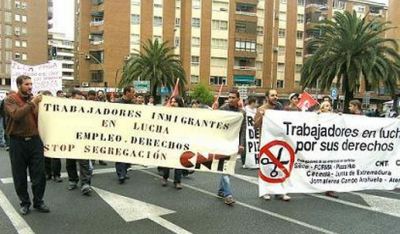
Aunque lejos de la histórica preponderancia que tuvo en el campo, la Confederación está desarrollando una importante actividad en el sector agroalimentario. No sólo entre los jornaleros de los tradicionales latifundios -donde siguen destacando los sindicatos de Extremadura y Andalucía- o entre los mares de cultivo bajo plástico del poniente almeriense sino también en un novedoso frente el del consumo responsable y agroecológico. No es de extrañar por tanto que la CNT buscase adecuar su posición en el sector desarrollando unos acuerdos específicos en el X Congreso (Córdoba, 2010).
CONTRIBUCIÓN A LA LUCHA CAMPESINA Y AGROECOLÓGICA
Hasta un 10% del PIB de la Región y el 15% de su población activa dependen directamente del sector primario, cifras muy alejadas del 4 y 5% (2008), respectivamente, nacionales. El convenio colectivo de trabajadores del campo extremeño es el que más trabajadores abarca (65.000) pues la comunidad se ha caracterizado históricamente (junto a Castilla-La Mancha y Andalucía) por el régimen de propiedad de la tierra (latifundio) y la consiguiente proletarización de la mayor parte de la masa campesina (jornaleros).
Members of ZSP Education union in Warsaw interviewed a comrade from Priama akcia in Slovakia about a recent one-day strike in education. This is the first in a series of planned interviews about the experiences of comrades in this field and is published in the framework of a campaign publicizing strikes and direct actions organized by education workers.
Hi. We have a few questions about the teachers' strike. What are the main demands?
Officially there are three demands and they are all related to money. The money spent on education in the 2013-2015 state budgets expressed that the percentage of the GDP spent on education should be comparable with other EU member states; all employees in the education sector should get higher real wages; teachers and specially trained education workers (school psychologists, speech therapists etc.) should get 1.2 to 2 times the average wage in the national economy
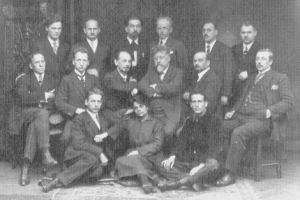
Dziewiędziesiąt lat temu, kongres założycielski IWMA (obecnie IWA) został dwukrotnie zakłócony przez policję. Kongres odbył się na przełomie 1922 i 1923 roku, w burzliwy okresie w którym na całym świecie wybuchały ruchy rewolucyjne, a socjaldemokratyczna międzynarodówka porzuciła swój internacjonalizm i każda z partii wchodzących w jej skład poparła „swój” rząd w nacjonalistycznej wojnie. W tym samym czasie doszło do zapaści reformistycznego ruchu związkowego.
Po zakończeniu Pierwszej Wojny Światowej wznowiono próby budowy międzynarodowych organizacji. W 1921 r. w Moskwie odbył się kongres założycielski tzw. „czerwonej międzynarodówki”. Poczyniono wiele kroków, by przyciągnąć w jej szeregi syndykalistów, jednak bez powodzenia, gdyż syndykaliści nie chcieli wiązać się z ruchem kierowanym przez polityków.
Pod koniec grudnia 1922 r., delegaci syndykalistyczni reprezentujący łącznie 2 miliony pracowników z 10 krajów spotkali się w Berlinie. Na tym kongresie powstała IWMA, czyli obecne Międzynarodowe Stowarzyszenie Pracowników.
Tento text je súhrnom skúseností bývalých zamestnancov jednej zo známych slovenských mimovládnych organizácií (MVO). Jeho cieľom je poukázať na niektoré bežné praktiky v treťom sektore, podeliť sa o skúsenosti s pracovným procesom a podmienkami s tými, ktorí o práci v tomto sektore uvažujú, prípadne ju momentálne vykonávajú. Text je písaný striedavo v jednotnom a množnom čísle, pretože opisuje individuálne aj kolektívne skúsenosti.
The “first” International Workingmen´s Association was founded in 1864 through the initiative of workers themselves but also with some participation of “politicians”. Organizationally, it was built as an association of workers´ unions. According to the Statutes, there was no centralism. The workers of the same profession or area formed a section, all sections of any country formed a federation, and every country federation sent delegates to the General Council. This Council was purely a coordinating body - it could not issue any decrees, instructions, etc.
La “primera” Asociación Internacional de Trabajadores fue fundada en 1864 a través de la iniciativa de los propios trabajadores pero también con alguna participación de “políticos”. Organizativamente, fue construida como una asociación de sindicatos obreros. Según sus estatutos no había centralismo. Los trabajadores de la misma profesión o área formaban una sección, todas las secciones de un país formaban una federación, y cada federación nacional enviaba delegados al Consejo General. Este Consejo era un órgano puramente coordinador, no podía emitir decretos, instrucciones, etc.
Det er i år 125 år siden Haymarket martyrene ble hengt i Chicago. De stod i spissen for kampen for 8-timersdagen i 1886, og 8 anarkister ble urettmessig beskyldt for å ha kastet en bombe på et massemøte. 4 av dem ble hengt i 1887 og en døde i fengsel. De er senere blitt symbolet for 1. mai og det er til minne om disse anarkistene vi demonstrerer på arbeiderklassens internasjonale kampdag!